
Pick up almost any single cask bottle and the label will tell you what it matured in. Ruby port barrique. Sherry hogshead. First fill bourbon barrel. Refill butt.
It reads like a spec sheet written for somebody else. Most people scan past it, buy the bottle for the distillery name, and never find out that the second half of that sentence had more to do with the flavor than the first half did.
So here is the whole vocabulary, in the order it matters.
The cask is not a container
Start here, because everything else follows from it. New make spirit comes off the still clear, sharp, and roughly the same across a lot of distilleries that swear otherwise. It is grain alcohol with character but very little color, sweetness, or depth.
Ask people in the industry how much of a finished whisky comes from the wood rather than the spirit and the estimates land somewhere between sixty and eighty percent. Argue with the exact number if you like. The direction is not in dispute. The cask is doing most of the work.
A distillery gives you the accent. The cask gives you most of the vocabulary.
Which means when a label names the wood, it is not trivia. It is the single most useful thing printed on the bottle after the age.
Size is a clock, not a quality
Cask names are mostly size names. This is the part nobody explains.
An American standard barrel holds about 200 litres. A hogshead is a barrel taken apart and rebuilt slightly larger with extra staves, around 250 litres. A barrique comes out of the wine world at roughly 225 to 300 litres. A butt, the classic sherry cask, holds about 500 litres and stands tall and narrow. A puncheon holds a little more, around 550, in a shorter and considerably wider shape.
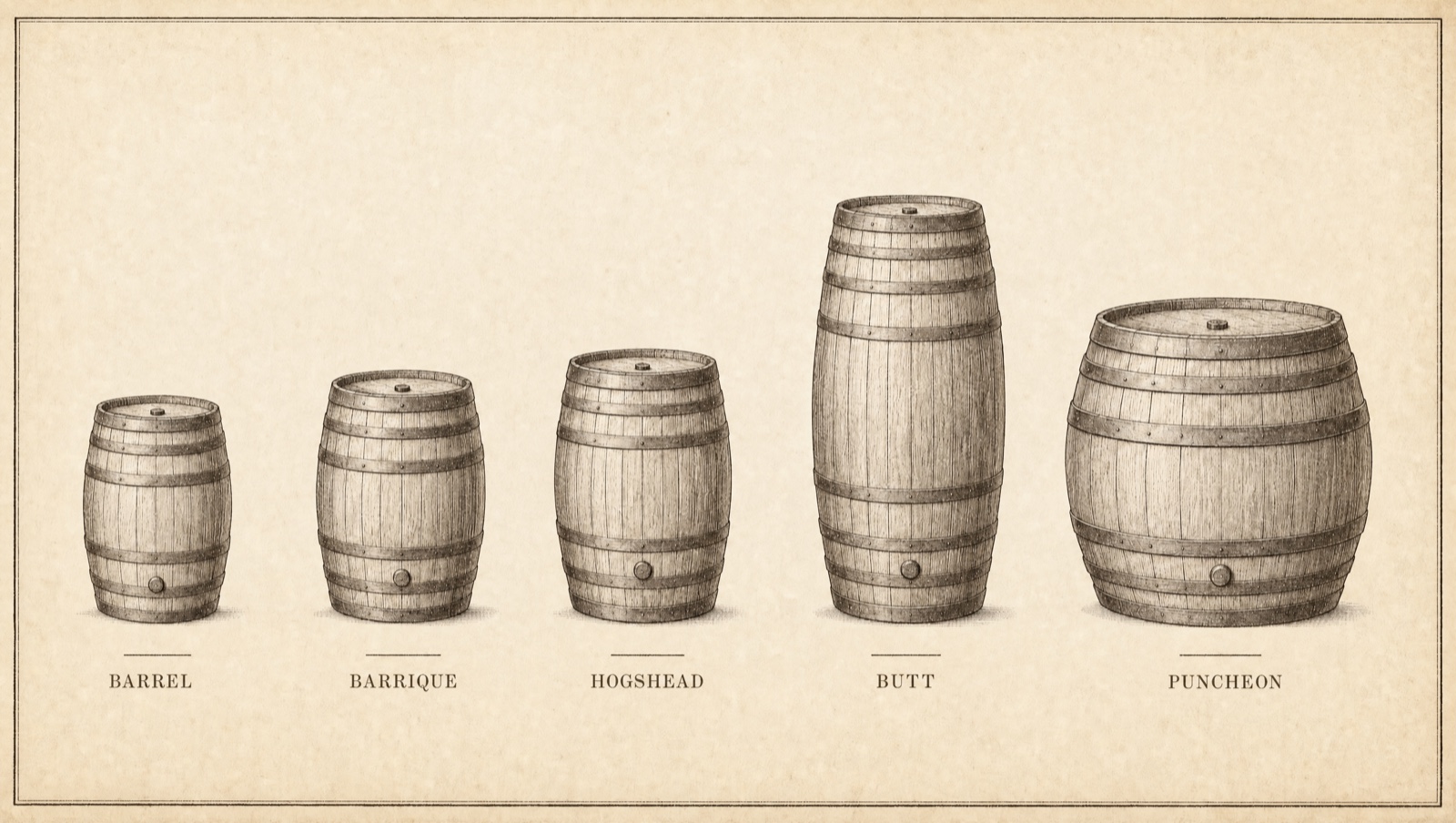
What changes with size is the ratio of wood surface to liquid. A small cask puts more oak in contact with less whisky, so it works faster. A butt holds two and a half times the liquid of a barrel against proportionally less wood, so it works slowly.
Faster is not better. It is just faster. A small cask can deliver a gorgeous result in eight years or turn a spirit into a mouthful of tannin and sawdust in twelve. A big sherry butt can take twenty years to say what it has to say and be worth every one of them. Size tells you how quickly the wood is talking, not how well.
Where the names came from
None of these words were invented for whisky. They are old trade measures, and most of them arrived in the distillery by accident.
A hogshead was a unit long before it was a whisky cask. It turns up in English records from the fifteenth century as a measure of wine and beer, and the usual account is that the word is a mangling of the Dutch oxhooft, an ox head, which is what the cask was called before English speakers got hold of it. There is no pig anywhere in the story. Nobody can prove that derivation, but every competing explanation is worse.
A butt is older still and duller. It comes from the Latin buttis, a cask, by way of medieval French and Italian, and it has meant a large cask for something like a thousand years. A puncheon most likely takes its name from the mark punched into the head of the cask by the cooper who made it, which is the kind of etymology that sounds invented and probably is not. A barrique is simply the French word, and it comes with Bordeaux attached: when a label says barrique, it is telling you the cask arrived from the wine trade rather than the whisky one.
Hogshead or barrel
One line above did not do this comparison justice, and it is the one people ask about most.
A hogshead starts life as an American standard barrel. A cooper takes the barrel apart, adds staves, fits new ends and rebuilds it about a quarter larger: roughly 250 litres against the barrel’s 200. Same oak, same bourbon history, bigger cask.
What the extra volume buys is time. More liquid against proportionally less wood means a hogshead matures a little more slowly and a little more evenly than the barrel it was made from. It also means more bottles at the end, something like 250 to 300 where a barrel gives 200 to 250, with the angel’s share deciding how much of that survives the wait.
Quarter casks, octaves and blood tubs
Below the barrel sits a whole family of small casks, and they exist because whisky used to travel on animals.
A quarter cask holds about 125 litres, a quarter of a butt, and it was the size that fitted on a packhorse. That made it the farm cask and the smuggler’s cask. Today it gets used deliberately: that much oak against that little whisky matures at a rate no full size cask can approach, which is why a quarter cask bottling can taste far older than its age statement, and why it can go wrong in a hurry.
An octave is smaller again, around 50 litres, an eighth of a butt, used mostly for short finishing runs where a few months are meant to do the work of a few years.
A blood tub is the odd one. Roughly 40 litres, built narrow and oval rather than round so it would sit flat against a horse’s flank instead of digging into it. The name is poorly documented and every explanation offered for it is unverifiable, which usually means the truth is duller than all of them. Almost nobody fills them now.
The rule holds all the way down the scale. The smaller the cask, the faster the conversation, and the less room there is to get the timing wrong.
What the wood held before
Almost no Scotch matures in new oak. The cask arrives with a history, and that history is the flavor.
Ex-bourbon is the workhorse, American oak that held bourbon for a few years first. American oak is high in lactones, which is where you get vanilla, coconut, honey, and soft baking spice. It is the taste most people think of as classic Speyside, and it is generous without being loud.
Sherry casks are usually European oak that held oloroso, PX, or fino. European oak carries far more tannin and a different aromatic set: dried fruit, fig, dark sugar, clove, leather, sometimes a struck-match note. Sherry wood is assertive. Give it a delicate spirit and it will simply talk over it.
Wine and fortified wine casks are the wild ones. Port, madeira, sauternes, red burgundy. Port in particular pushes red fruit and a rose-amber color that is unmistakable in the glass. These casks are less predictable than sherry or bourbon, which is exactly why they are interesting and exactly why more of them fail.
The cask is not neutral and was never meant to be. You are tasting the previous tenant.
First fill and refill
This is the term that trips up the most people, and it is the simplest one.
A cask holds a finite amount of extractable flavor. First fill means the cask is holding Scotch for the first time since it held bourbon or sherry. It is loaded. Everything the previous spirit left behind is still in the wood, and the whisky will pull hard on it.
Second fill and refill mean the cask has already given a good portion of that away. It works gently. It contributes color and structure without dominating.
Sherry casks in particular are worth reading closely, because the modern ones are made to order rather than inherited from the sherry trade, which we get into in what a sherry hogshead actually is.
Neither is the better cask. A first fill sherry butt on a big, oily spirit is a thrilling combination. That same butt on something delicate erases the distillery entirely, and you end up with a whisky that tastes like sherry rather than like Speyside. Plenty of very expensive bottles have exactly that problem. A refill cask is often the honest choice when the spirit is good enough to be heard.
Finishing versus full maturation
One more distinction worth knowing, because it hides behind similar language.
Full maturation means the whisky spent its entire life in that cask. A finish means it spent most of its life somewhere else, usually ex-bourbon, and was moved into a second cask for the last stretch. Months, sometimes a couple of years.
Done well, a finish adds a layer the original cask could not. Done badly, it is a rescue mission: a mediocre parcel of whisky dropped into a loud cask for eight months so that something interesting ends up on the nose. Both of those are legally allowed to say the same thing on the label.
The tell is usually time and specificity. A producer who is proud of a finish will tell you how long it ran and what the cask was. A producer running a rescue tends to stay vague.
Reading our labels
Which brings us back to our own bottles, and why we print all of this on the front.
Our Linkwood 12 Year Ruby Port Barrique is a smaller cask holding a light, floral Speyside spirit. More wood contact against less liquid, which is why twelve years in a port barrique gives you more color and more fruit than twelve years in a standard barrel would. The risk with a barrique is running past the point where the wood stops flattering the spirit. That is a timing decision, and it is the one we spend the most time arguing about.
Our Paul John Sherry Hogshead works the other way. Goa is hot, so the whisky matures fast and loses a great deal to the angel's share every year. Put that intensity in a 500 litre butt and the wood would never catch up. A hogshead is the sensible size for a spirit already moving quickly.
Neither of those choices was ours to make, which is the honest part. We buy casks that already exist, filled and laid down years before we ever tasted them. What we control is which ones we say yes to, and we say no far more often than we say yes.
The short version
Size sets the pace. The previous contents set the flavor. Fill number sets the volume. Finish tells you whether the cask raised the whisky or just met it at the end.
Four pieces of information, all of them usually printed right there on the label, all of them worth more than the marketing copy above them. Next time you are standing in front of a shelf, read the small line under the distillery name first.
It will tell you more about what is in the bottle than anything else on it.